Seizures in Dogs: Symptoms, Causes, and What To Do
What Are Seizures in Dogs?
Seizures in dogs are caused by a sudden surge of uncontrolled electrical activity within the brain. The signs and severity of a seizure depend on which areas of the brain are affected and how widely that activity spreads.
Some seizures are brief and self-limiting. Others can be life-threatening and require urgent veterinary intervention. While witnessing a seizure is distressing, many dogs with appropriate diagnosis and management can live long, stable, and fulfilling lives.
Seizures vs Look-Alike Conditions
Not all abnormal movements are seizures.
Muscle tremors, shivering, and even vivid dreaming can be mistaken for seizure activity. The key difference is awareness.
Dogs experiencing tremors or shivering remain aware of their surroundings
Dogs having most types of seizures show altered awareness, confusion, or loss of consciousness
Because some seizures do not involve full loss of consciousness, diagnosis is not always straightforward.
If possible, video recording an episode can be extremely helpful for your veterinarian.
Types of Seizures in Dogs
Generalised Seizures
Generalised seizures occur when abnormal electrical activity affects most or all of the brain.
These are the seizures most people picture and often involve the entire body.
Common features include:
Loss of consciousness
Body stiffness
Limb paddling or jerking
Jaw chomping or biting at the air
Involuntary urination or defecation
Variants of generalised seizures include:
Tonic seizures – stiffness without paddling
Clonic seizures – paddling without stiffness
Atonic or absence-type seizures – sudden loss of consciousness without convulsions
Focal (Partial) Seizures
Focal seizures involve abnormal electrical activity in a specific area of the brain.
Signs are often localised and may include:
Facial twitching
Lip or eyelid movements
Fly-biting or snapping at the air
Repetitive licking
Repeated movement of one limb
Awareness may be normal or altered.
Focal seizures without altered awareness may be called partial motor seizures, while those involving behavioural changes or confusion may be referred to as complex partial or psychomotor seizures.
Focal seizures can sometimes progress into generalised seizures.
Phases of a Seizure
Generalised seizures typically occur in three stages.
Pre-ictal Phase (Aura)
This phase occurs before the seizure itself and may last seconds to minutes.
Signs may include:
Restlessness or anxiety
Clinginess or withdrawal
Staring into space
Unusual behaviour
Ictal Phase (The Seizure)
This is the active seizure phase.
Dogs may:
Collapse
Become rigid
Paddle their limbs
Lose awareness
Vocalise
Lose bladder or bowel control
Post-ictal Phase (Recovery)
After the seizure, dogs often experience a recovery period.
Signs may include:
Confusion or disorientation
Weakness or unsteady walking
Restlessness or agitation
Temporary blindness
Lethargy
This phase can last minutes to hours and is often longer after severe or prolonged seizures.
What To Do If Your Dog Has a Seizure
Stay calm. Most seizures last less than one minute and resolve on their own.
During the seizure:
Remove nearby hazards
Do not restrain your dog
Do not put anything in their mouth
Gently move them only if they are in danger (stairs, road)
After the seizure:
Keep your dog in a quiet, safe area
Allow them time to recover
Offer water once they are steady
Delay feeding until they are fully alert
When Seizures Are an Emergency
Seek immediate veterinary attention if your dog experiences:
A seizure lasting longer than five minutes
Multiple seizures without recovery in between (cluster seizures)
More than two seizures within 24 hours
These situations can cause serious neurological damage and can be life-threatening.
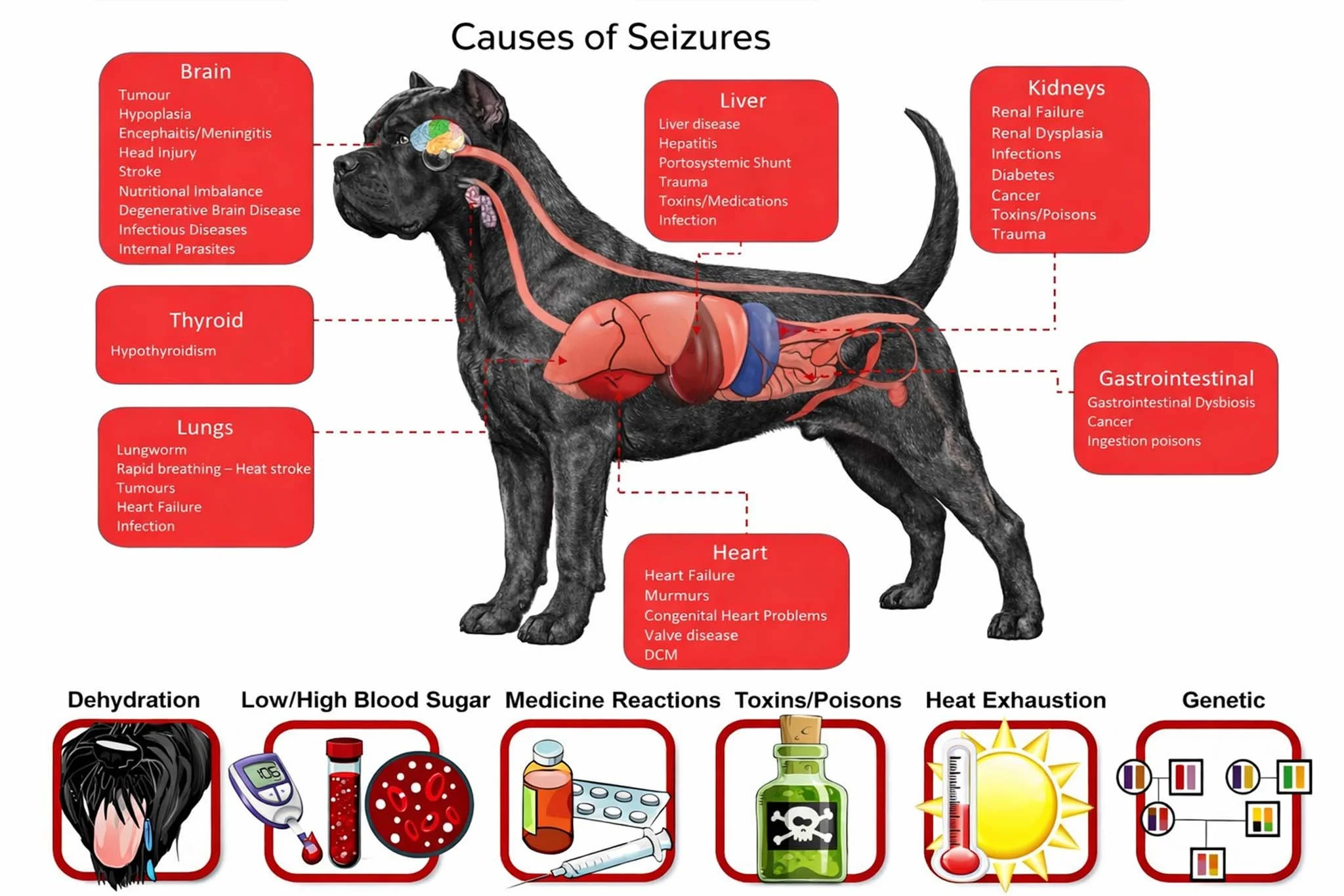
Causes of Seizures in Dogs
Seizures can result from many underlying conditions, including:
Brain infection or inflammation
Brain tumours
Head trauma
Metabolic disorders (low blood sugar, calcium imbalance)
Liver or kidney disease
Toxic exposure (lead, antifreeze, certain drugs)
Congenital abnormalities such as hydrocephalus
Heatstroke
In some cases, no underlying cause is identified.
Idiopathic (Primary) Epilepsy
When dogs experience recurrent seizures and no underlying cause is found, they are diagnosed with idiopathic epilepsy.
Key points:
Most common cause of seizures in young dogs
Typically begins between 1–4 years of age
Likely has a genetic component
Seen more commonly in certain breeds
Idiopathic epilepsy does not mean seizures are untreatable. Many dogs respond well to long-term management, although some require careful adjustment of treatment over time.